English
 Arabic
 French
 Spanish
 Portuguese
 Deutsch
 Turkish
 Dutch
Dutch
 Italiano
 Russian
 Romaian
 Portuguese (Brazil)
 Greek
Greek
Remote Robot Monitoring Services Market to Reach USD 6.4 Billion by 2032
Other |
2026-02-17 12:45:02

For many students, aviation begins with a single image. A large jet. A uniform. A crowded terminal. Airlines dominate the imagination.
Yet the cockpit is wider than that image suggests.
A private aircraft license often feels like the first small step into aviation. In truth, it can be the door to directions many aspiring pilots never consider. Airlines are only one branch of a much larger tree. When you look closer, the industry opens into corporate hangars, remote airstrips, training fleets, medical evacuation units, survey operations, and private terminals where schedules are built around people, not passenger loads.
Understanding these early changes helps you plan your training and your career.
At its core, a private aircraft license teaches command responsibility. You are not a co-pilot in training. You are the pilot in command of a light aircraft, responsible for navigation, safety decisions, weather judgment, and airspace awareness.
That shift in responsibility shapes your professional mindset.
You learn:
These are not airline-specific skills. They are pilot skills. And pilot skills travel across sectors.
Many students assume airlines are the only viable long-term goal. That assumption limits vision. Aviation offers diverse career pathways where a private aviation license becomes a powerful starting point.
Below is a simplified overview.
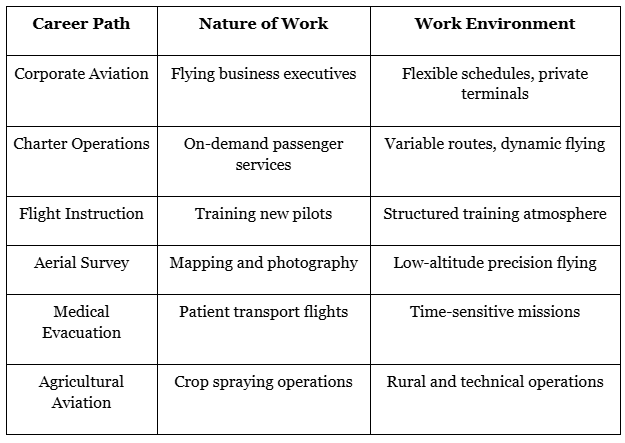
Each pathway requires additional ratings or experience, of course. But the base qualification matters. The license forms the platform.
Corporate flying often appeals to pilots who value flexibility and closer client interaction. Flights are tailored. Schedules may be irregular, but they are not mass-transport routines.
A typical day in corporate aviation can involve:
Unlike airline rosters, corporate flying feels personal. For some, that environment fits better than a large airline structure.
Charter operations require adaptability. Routes change. Timings shift. Aircraft types vary.
Pilots in this sector often gain diverse experience quickly because no two weeks look identical. Exposure to varied airspace, airport conditions, and passenger profiles sharpens practical skills.
Students who begin with a private aviation license often find charter pathways accessible after progressing through additional training stages.
There is something quietly powerful about teaching. Many pilots choose to become flight instructors early in their careers, building hours while mentoring new students.
Advantages include:
Explaining airspace rules or stall recovery techniques forces deeper comprehension. Teaching strengthens your own flying.
Survey flying demands precision. Whether it involves mapping land, inspecting pipelines, or supporting environmental research, the work requires steady hands and disciplined altitude control.
These operations rarely make headlines, yet they remain vital.
Skills commonly required:
Pilots who enjoy technical challenges often find this field satisfying.
A brief comparison may help clarify how paths differ.
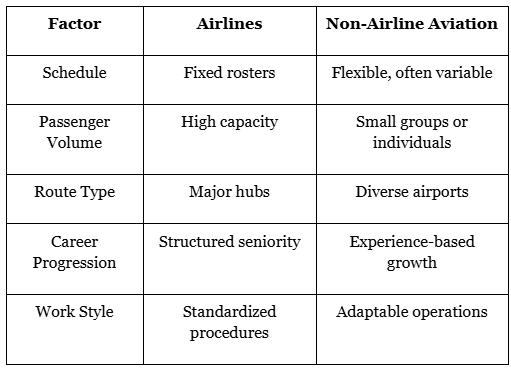
Neither route is better. They are simply different.
The key point is choice. A private aircraft license expands that choice.
Non-airline aviation often demands broader involvement. Pilots may participate in:
This multi-dimensional exposure builds professional maturity early. It sharpens judgment and communication skills in ways that purely airline-focused training may not emphasize initially.
It would be unrealistic to ignore practical aspects.
Some non-airline sectors offer faster initial cockpit opportunities. Others provide lifestyle flexibility that airlines may not. In certain cases, pilots combine roles, flying charter while instructing part-time.
This flexibility can be valuable in the early years of career development.
A private aviation license does not replace advanced certifications. It prepares you for them.
Progression often looks like this:
Starting with a strong foundation improves each subsequent stage.
The aviation world includes cabin crew, ground staff, dispatchers, engineers, and operations specialists. Students exploring training options sometimes compare pilot pathways with hospitality-focused programs such as those offered by the best air hostess training institute in Delhi.
Both roles serve aviation, yet they demand different commitments and skill sets. Understanding this spectrum helps aspiring professionals choose paths aligned with their strengths.
Piloting is not the only prestigious aviation career. But for those drawn to the controls, expanding perspective beyond airlines brings clarity.
Non-airline aviation still demands discipline. Early mornings. Technical study. Weather monitoring. Medical fitness standards. None of that disappears.
However, the reward lies in variety. The view from a charter turboprop into a remote airstrip differs from descending into a busy metropolitan hub. Both carry responsibility. Both demand focus.
The difference lies in rhythm.
Some pilots thrive on airline structure. Others prefer adaptable schedules and closer operational involvement.
Knowing this early saves years of uncertainty.
A private aircraft license is more than a beginner’s qualification. It is the first command position, the first independent flight plan, the first real taste of aviation responsibility. More importantly, it opens doors that extend far beyond airline cabins.
For aspiring pilots seeking structured training and long-term career direction, Fly Wings provides guidance to navigate those possibilities with clarity and confidence.