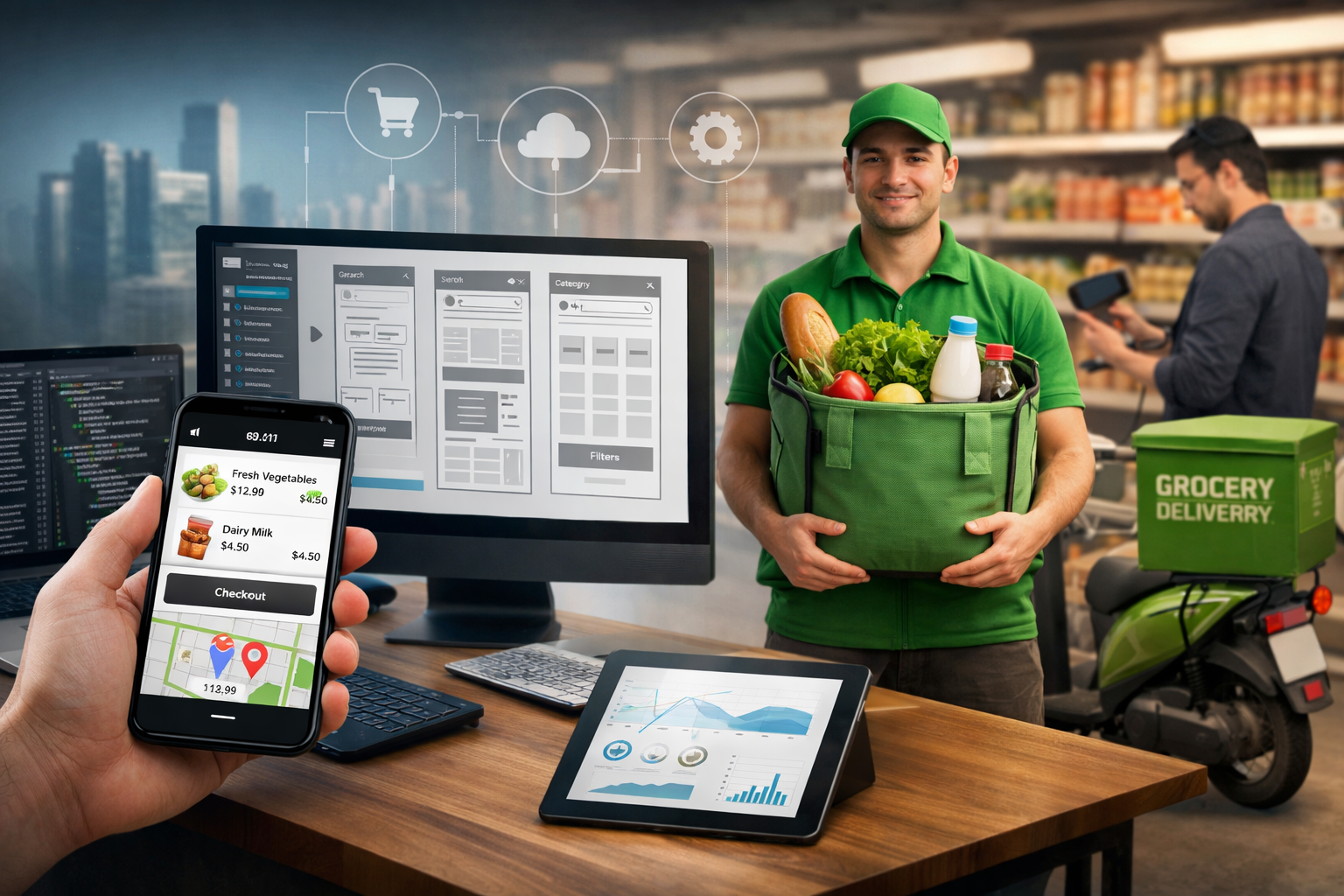
The grocery retail industry is undergoing rapid digital transformation. Changing customer behavior, the growth of hyperlocal delivery models, and the demand for seamless online experiences have pushed traditional retailers to adopt digital platforms quickly. However, building a scalable grocery application is not just about launching an app, it requires strategic planning, robust technology, logistics integration, and continuous optimization. This is where a grocery app development company plays a crucial role. By offering industry expertise, ready frameworks, and scalable solutions, these companies help retail businesses accelerate digital adoption without compromising quality or performance.
Understanding the Digital Shift in Grocery Retail
Retail grocery businesses once relied entirely on walk-in customers. Today, customers expect online browsing, real-time inventory updates, digital payments, scheduled deliveries, and personalized recommendations. The rise of online-first platforms and hybrid retail models has made digital presence a competitive necessity rather than an optional upgrade.
Retailers face several challenges when transitioning to digital:
- Managing large product catalogs with frequent inventory updates
- Integrating point-of-sale systems with online platforms
- Setting up logistics and last-mile delivery
- Ensuring secure digital payments
- Maintaining consistent customer experience across channels
A professional grocery app development company understands these operational challenges and builds solutions that address them systematically.
The Strategic Role of a Grocery App Development Company in Retail Digitization
A grocery app development company does much more than coding and UI design. It acts as a digital transformation partner. From conceptualization to deployment and post-launch optimization, the company ensures that retail businesses move online quickly and efficiently.
Business Analysis and Requirement Mapping
Before development begins, experts conduct detailed business analysis. They assess store size, product range, delivery radius, target audience, competition, and operational capacity. This ensures that the final product aligns with real business needs rather than generic templates.
Custom Architecture for Scalability
Retailers often start with a limited geographic area but plan to expand. Developers design scalable architectures using modular backend systems, cloud integration, and flexible databases that can handle growth in users, transactions, and inventory without system breakdown.
Faster Deployment Using Proven Frameworks
Instead of building everything from scratch, development companies use tested modules and reusable components. This significantly reduces development time and speeds up go-to-market timelines.
Accelerating Market Entry Through On Demand Grocery Delivery App Development
Speed is critical in competitive markets. On demand grocery delivery app development enables retailers to launch quickly with essential features that customers expect.
Core Features That Enable Quick Market Launch
- Real-time product browsing and search
- Smart filtering by category, price, and brand
- Secure payment gateways
- Order tracking and delivery scheduling
- Push notifications and promotional tools
By focusing on high-impact features first, retailers can launch a minimum viable product quickly and upgrade later based on user feedback.
Integration with Logistics and Inventory Systems
One of the most time-consuming aspects of digital transition is logistics integration. A development company connects inventory management systems with online ordering platforms. This prevents overselling and ensures real-time stock visibility.
Delivery management systems with route optimization, delivery partner dashboards, and automated dispatch significantly streamline operations.
Reducing Operational Bottlenecks
Automated billing, digital invoicing, and analytics dashboards eliminate manual processes. This improves order accuracy, reduces labor dependency, and increases operational efficiency from day one.
White Label Grocery Delivery App: A Cost-Effective Fast-Track Solution
For retailers looking for even faster deployment, a white label grocery delivery app offers a ready-to-launch framework that can be customized with brand identity and business logic.
What Makes White Label Solutions Attractive
White label platforms come pre-built with essential features such as:
- Customer app
- Admin dashboard
- Delivery partner app
- Inventory management tools
- Payment gateway integration
Instead of spending months in development, retailers can customize branding elements like logos, themes, and content while leveraging an already-tested technical structure.
Lower Development Risk and Faster ROI
Because the base product has already been tested in the market, technical risks are significantly reduced. Retailers can focus on marketing and customer acquisition rather than worrying about debugging core infrastructure.
Customization Without Compromising Identity
White label does not mean limited flexibility. Advanced customization options allow integration of loyalty programs, subscription-based delivery, region-specific pricing models, and language preferences.
Enhancing Customer Experience Through Smart Technology Implementation
Digital success depends on user experience. A grocery app development company designs intuitive interfaces and smooth navigation structures that reduce cart abandonment.
User-Centric Design Principles
- Simple onboarding process
- One-click reordering
- Personalized product recommendations
- Seamless checkout experience
- Multi-payment options
These features create convenience, which is the primary driver of online grocery adoption.
AI and Data-Driven Personalization
Advanced development teams integrate artificial intelligence to analyze purchasing patterns and recommend products accordingly. Personalized discounts, seasonal promotions, and smart reminders enhance customer retention.
Performance Optimization and Security
High traffic during peak hours can crash poorly built apps. Developers implement load balancing, server optimization, and secure encryption protocols to maintain app stability and data protection.
Streamlining Backend Operations for Retailers
Going digital is not only about front-end customer experience. Backend automation is equally important.
Real-Time Inventory Management
Automated synchronization between physical stores and online platforms ensures accurate stock updates. Retailers can set alerts for low inventory and automate restocking processes.
Vendor and Supplier Integration
Multi-vendor modules allow integration of multiple suppliers within the same platform. This helps businesses expand product variety without increasing internal operational burden.
Advanced Analytics and Reporting
Comprehensive dashboards provide insights into:
- Best-selling products
- Peak ordering times
- Customer demographics
- Revenue trends
These insights enable data-driven decisions and better marketing strategies.
Scaling from Local Store to Hyperlocal Marketplace
A reliable grocery app development company builds systems that support future expansion.
Multi-Store and Multi-Location Support
Retail chains can manage multiple outlets under one centralized admin panel. Location-based pricing and inventory visibility ensure efficient regional management.
Hyperlocal Marketplace Model
Retailers can transform from a single-store model into a marketplace connecting multiple local vendors. This opens new revenue streams through commission models.
Cloud Infrastructure for Growth
Cloud-based hosting ensures scalability. As order volumes increase, the system can scale resources dynamically without downtime.
Continuous Support and Post-Launch Optimization
Launching the app is only the beginning. Continuous updates, performance monitoring, and feature upgrades are necessary for long-term success.
Maintenance and Technical Support
A development partner provides ongoing bug fixes, security patches, and compatibility updates with new operating systems.
Feature Enhancements Based on User Feedback
Customer reviews and behavior analytics help identify improvement areas. Development teams release regular updates to enhance usability and introduce competitive features.
Marketing and Growth Integration
Some companies also assist with digital marketing tools such as referral programs, discount engines, and loyalty systems integrated directly into the app.
Why Retail Businesses Should Partner Instead of Building In-House
Building an internal development team requires hiring designers, backend developers, frontend engineers, QA specialists, and DevOps experts. This significantly increases costs and time.
Partnering with an experienced grocery app development company ensures:
- Faster deployment timelines
- Lower initial investment
- Access to experienced developers
- Reduced technical risk
- Ongoing technical support
Retailers can focus on sourcing products and serving customers while technology experts handle digital infrastructure.
Conclusion
Digital transformation in grocery retail is no longer optional. Consumers expect seamless online ordering and fast delivery services. A professional grocery app development company accelerates this transition by offering scalable technology, streamlined logistics integration, and user-centric design. Whether through custom development, on demand grocery delivery app development, or a white label grocery delivery app, retailers can go digital faster, reduce operational complexity, and create new revenue opportunities. By choosing the right development partner, businesses position themselves for long-term growth in an increasingly competitive digital marketplace.
Frequently Asked Questions
What does a grocery app development company typically provide?
A grocery app development company provides end-to-end services including business analysis, UI/UX design, backend and frontend development, inventory integration, payment gateway setup, testing, deployment, and post-launch maintenance.
How long does on demand grocery delivery app development take?
The timeline depends on feature complexity and customization requirements. A basic version may take a few weeks, while a fully customized solution with advanced integrations may take several months.
Is a white label grocery delivery app suitable for small retailers?
Yes, a white label grocery delivery app is often ideal for small and mid-sized retailers because it reduces development time and cost while providing essential features for online operations.
Can grocery apps integrate with existing POS systems?
Yes, experienced development companies can integrate grocery applications with existing POS and inventory management systems to ensure real-time stock updates and smooth operations.
How much does it cost to build a grocery delivery app?
The cost varies depending on customization level, feature set, platform selection, and scalability requirements. White label solutions are generally more cost-effective than fully custom-built applications.
 English
 Arabic
 French
 Spanish
 Portuguese
 Deutsch
 Turkish
 Dutch
Dutch
 Italiano
 Russian
 Romaian
 Portuguese (Brazil)
 Greek
Greek